Showing posts with label Jatropha hybrid. Show all posts

Friday, February 1, 2013

Jatropha patents and intellectual property

Recently we performed a simple patent search for "Jatropha". The result was quite stunning! Lots of patents have been granted or are under application regarding the commercial exploitation of this interesting plant.

So let's group them a little bit:
  1. Superior (or special) Jatropha cultivars and methods to create the same
    Includes several hybrid developments by Nandan and an attempt by SG Biofuels Ltd. to patent a male-sterile trait in Jatropha. (More about the latter follows below)
  2. Genetic manipulation of certain traits
    Specifically Joil's approach to improve Jatropha oil quality through the transfer of a certain gene sequence from Castor. (We keep arguing that the same result can be achieved by conservative breeding, no GMO necessary)
  3. Mass propagation of Jatropha
    Mainly but not exclusively about tissue culture, i.e. protocols for in-vitro vegetative propagation.
  4. Detoxification of Jatropha
    Several combinations of chemical and/or mechanical separation processes can do the job.
  5. Jatropha-to-fuel processing methods
    Special methods for producing biodiesel and other fuels from Jatropha and Jatropha oil respectively.
We started checking patent regulations to find out what can really be patented in and around a plant or better, what cannot be patented. And I can tell you, that's one of the most confusing quagmires our great politicians ever created. Anyway, there are 2 globally common denominators we can highlight here:
  1. No wild plant or trait of a wild plant can ever be protected by a patent (or plant breeders rights), even if it was discovered for the very first time.
  2. Any variety protected by a patent or other plant breeder rights can be used by other breeders for further breeding without any obligations to license the original material.
Now we are specifically looking at an SG Biofuels patent application regarding a "female-only" trait in Jatropha curcas which would have serious consequences for our Jatropha Breeder 3.0 platform and others if ever granted. The patent application claims a male-sterile trait in Jatropha which is described as the result of expert hybrid breeding and not further qualified by DNA fingerprinting. If hybrid crossing, as claimed, would be the only way known of obtaining this important trait for breeders, everyone would be out of luck by now. Fortunately for us and the industry, Bionic Palm is in possession of several male-sterile Jatropha plants which are direct descendants of wild Jatropha plants at the center of origin in Guatemala and Mexico. No breeding or crossing was ever involved in their creation.

Therefore above exclusion no1 applies: a trait present in a wild plant can never be patented. We will have to wait and monitor carefully, if patent authorities in any of the many countries where this application is running in parallel will overlook the disclosure by Bionic Palm and grant the patent. In this case a formal complaint will have to be filed within 9 months.

In our opinion this little case story reveals how dangerous the IP arena has become for everyone. And how risky it is, not to constantly monitor new applications in your field of work. Patents today are viewed very differently by different organizations. While most simply and rightly just want to protect their development work, some seem to be eager making the accumulation of patented IP the core of their business, often benefiting from the work of others in the process.

A few weeks ago we had not expected, that Jatropha plant development has started becoming a playing field for IP hawks like Information Technology or Mobile Communication. But that definitely seems to be the case...

Monday, November 26, 2012

A 3-way interspecific Jatropha hybrid has been born

Seed comparisonBHX1 Jatropha interspecific hybrid (6 DAS)BHX2 Jatropha interspecific hybrid (7 DAS)BHX1 Jatropha interspecific hybrid (10 DAS)

A 3-way interspecific Jatropha hybrid, a picture set on Flickr following the development.
To the best of our knowledge this is a first in commercial hybrid Jatropha breeding history: Bionic Palm has succeeded to naturally create an innovative interspecific hybrid which contains genetic material from 3 different Jatropha species. No GMO was involved in the process.

Over the coming 12 to 18 months breeding specialists will explore all angles of this exciting success. This group of plants has the potential to mark the beginning of a new era in the development of commercially viable Jatropha planting material. It opens the route to a plethora of new traits including the potential to develop semi-annual Jatropha curcas hybrids similar to commercial Castor varieties. Still in its earliest state, this development could of course turn out a complete failure. Only time will tell.

Bionic Palm Jatropha breeders have worked for three years to identify a working breeding path that allows for this unique combination of genetic material. Already a large number of new crosses using genetically diverse parental interspecific hybrids are under development to confirm this break through. If reproduction turns out successful this approach will be available for the development of many new superior hybrid Jatropha cultivars.

In any case this was a key objective of Bionic Palm's Jatropha Breeder 3.0 platform development for the last 3 years. Finally getting there after many failures sets another milestone on the continuous success path of the project. Patent applications for the protocol that has been developed to make this procedure repetitive are under way.

Sunday, October 28, 2012

Bionic publishes formerly confidential presentation on Jatropha Breeding Platform

Bionic management took a bold decision recently on the public sharing of information from its Jatropha Breeding Program. Only information directly connected to pending patent applications will in the future remain confidential. This means that the main bulk of information and developed knowledge from one of the world's most advanced commercial Jatropha breeding activities can and will be shared publicly over time.

Bionic wants to set an example in modern, more open information exchange policies in the sector of commercial plant development.

In a first step today the full presentation on the Bionic Jatropha Breeding Platform was made public on the Bionic Palm website. Check it out here Bionic Jatropha Breeding Platform to learn about the details of modern plant breeding.

Sunday, September 30, 2012

Heterosis increases Jatropha seed weight 100% and more

Heterosis makes a difference in seed size!
It has been only a month since we last wrote on heterosis in Jatropha breeding. However, we had not seen then, what we have seen now…

We have harvested a handfull of seeds from the intraspecific hybrid exhibiting by far the strongest heterosis effects in leave size and height. And we were up for a real surprise.

We had recently seen 2 scientific reports on heterosis trials with Jatropha in South East Asia mentioning maximum positive heterosis in seed weight of up to 25%. We therefore really had not expected to see our highest 100-seed weight so far. Extrapolated from 20 harvested seeds it is slightly above 110g. Seed size can be compared very well in the picture above with control (small seeds on the right) being a typical average size Jatropha seed at a 100-seed weight of 56g.


Sunday, September 16, 2012

F2 Jatropha interspecific hybrids available

In the second half of August we successfully germinated the first three F2 seedlings from one of our interspecific hybrids. From now we have F2 Jatropha interspecific hybrids available for further breeding. While some research reports seem to indicate that this type of interspecific hybrid is sterile or not interesting for breeding, we observe an ongoing successful seed development on several of our early F1 plants deriving from different Jatropha curcas female parents.

Large diversity in F2 interspecific hybrids not unexpected
F2 seedlings of interspecific JcL hybrids 1 month old showing wide variation

As expected from applying general Mendel rules the F2 generation is much more genetically diverse than the F1 generation. Out of 3 seedlings so far, only the one on the left seems to be a strong and healthy plant while the other 2 are only moving along very slowly.

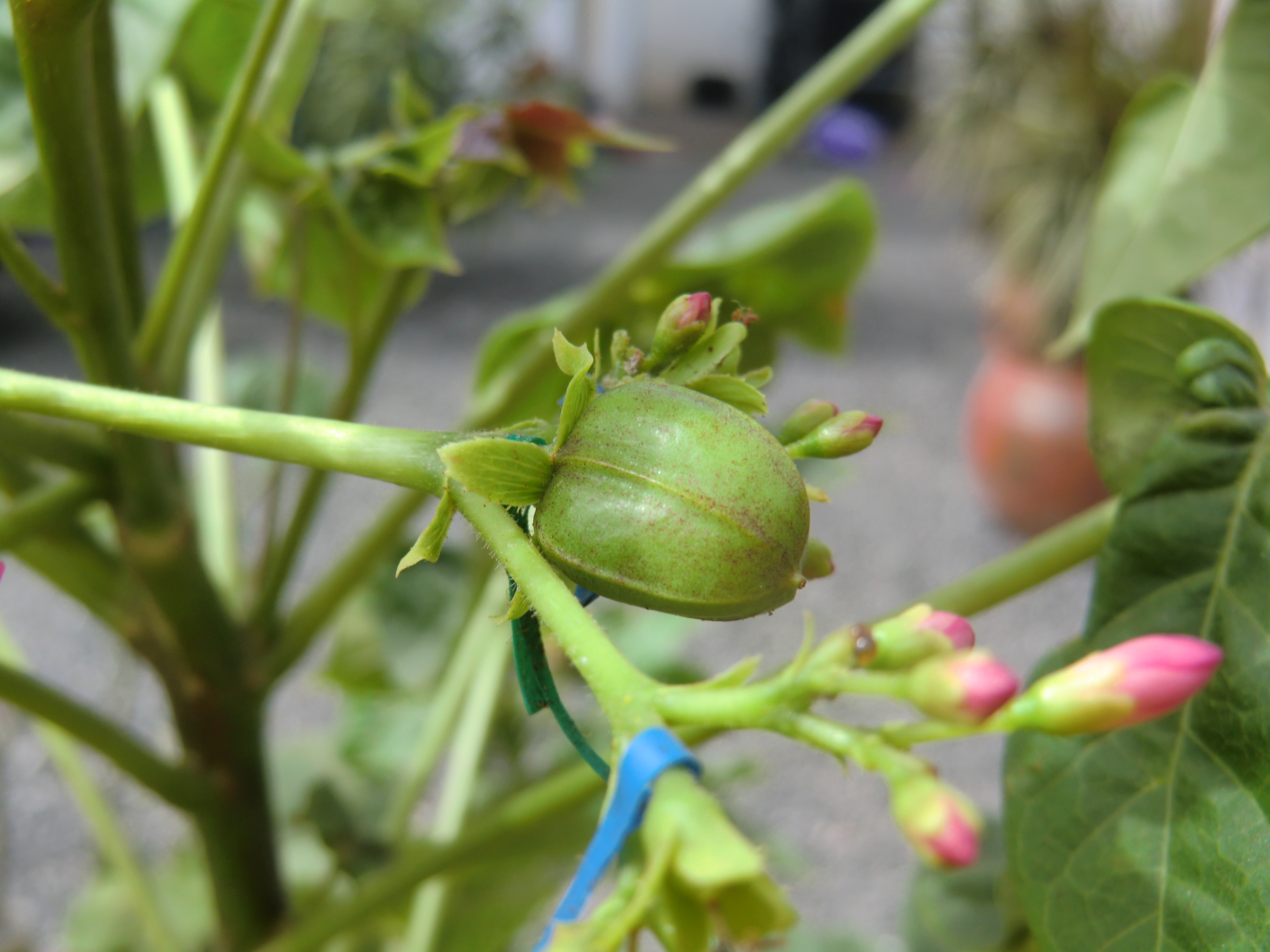
Fruit on an interspecific F1 hybrid
We expect our F2 interspecific population to grow very fast over the coming months involving many different F1 interspecific parents with genetically very different Jatropha curcas parents in turn. Currently many F1s are initiating their first flowering. On the interspecific route of our breeding program this is really what we have worked on for almost 3 years, as now we start moving into terrain which has not previously discussed in the scientific literature to the best of our knowledge.

This development marks another success in our initial target to bring as much variability into the germplasm available to us for future selective breeding. We are now able to work on a real ground breaking next step we had been planning for since we did the first interspecific cross almost 2 years ago. With a little luck results will become visible before the end of the year.

Further observations on the interspecific breeding route will be published here as much as possible, but of course we will have to start protecting our intellectual property where we reach the forefront of commercial hybrid development as we are expecting a meaningful patent application before too long.


F2 Jatropha interspecific hybrids available