Showing posts with label bionic palm. Show all posts

Monday, November 26, 2012

A 3-way interspecific Jatropha hybrid has been born

Seed comparisonBHX1 Jatropha interspecific hybrid (6 DAS)BHX2 Jatropha interspecific hybrid (7 DAS)BHX1 Jatropha interspecific hybrid (10 DAS)

A 3-way interspecific Jatropha hybrid, a picture set on Flickr following the development.
To the best of our knowledge this is a first in commercial hybrid Jatropha breeding history: Bionic Palm has succeeded to naturally create an innovative interspecific hybrid which contains genetic material from 3 different Jatropha species. No GMO was involved in the process.

Over the coming 12 to 18 months breeding specialists will explore all angles of this exciting success. This group of plants has the potential to mark the beginning of a new era in the development of commercially viable Jatropha planting material. It opens the route to a plethora of new traits including the potential to develop semi-annual Jatropha curcas hybrids similar to commercial Castor varieties. Still in its earliest state, this development could of course turn out a complete failure. Only time will tell.

Bionic Palm Jatropha breeders have worked for three years to identify a working breeding path that allows for this unique combination of genetic material. Already a large number of new crosses using genetically diverse parental interspecific hybrids are under development to confirm this break through. If reproduction turns out successful this approach will be available for the development of many new superior hybrid Jatropha cultivars.

In any case this was a key objective of Bionic Palm's Jatropha Breeder 3.0 platform development for the last 3 years. Finally getting there after many failures sets another milestone on the continuous success path of the project. Patent applications for the protocol that has been developed to make this procedure repetitive are under way.

Sunday, October 28, 2012

Bionic publishes formerly confidential presentation on Jatropha Breeding Platform

Bionic management took a bold decision recently on the public sharing of information from its Jatropha Breeding Program. Only information directly connected to pending patent applications will in the future remain confidential. This means that the main bulk of information and developed knowledge from one of the world's most advanced commercial Jatropha breeding activities can and will be shared publicly over time.

Bionic wants to set an example in modern, more open information exchange policies in the sector of commercial plant development.

In a first step today the full presentation on the Bionic Jatropha Breeding Platform was made public on the Bionic Palm website. Check it out here Bionic Jatropha Breeding Platform to learn about the details of modern plant breeding.

Sunday, September 30, 2012

Heterosis increases Jatropha seed weight 100% and more

Heterosis makes a difference in seed size!
It has been only a month since we last wrote on heterosis in Jatropha breeding. However, we had not seen then, what we have seen now…

We have harvested a handfull of seeds from the intraspecific hybrid exhibiting by far the strongest heterosis effects in leave size and height. And we were up for a real surprise.

We had recently seen 2 scientific reports on heterosis trials with Jatropha in South East Asia mentioning maximum positive heterosis in seed weight of up to 25%. We therefore really had not expected to see our highest 100-seed weight so far. Extrapolated from 20 harvested seeds it is slightly above 110g. Seed size can be compared very well in the picture above with control (small seeds on the right) being a typical average size Jatropha seed at a 100-seed weight of 56g.


Sunday, September 16, 2012

F2 Jatropha interspecific hybrids available

In the second half of August we successfully germinated the first three F2 seedlings from one of our interspecific hybrids. From now we have F2 Jatropha interspecific hybrids available for further breeding. While some research reports seem to indicate that this type of interspecific hybrid is sterile or not interesting for breeding, we observe an ongoing successful seed development on several of our early F1 plants deriving from different Jatropha curcas female parents.

Large diversity in F2 interspecific hybrids not unexpected
F2 seedlings of interspecific JcL hybrids 1 month old showing wide variation

As expected from applying general Mendel rules the F2 generation is much more genetically diverse than the F1 generation. Out of 3 seedlings so far, only the one on the left seems to be a strong and healthy plant while the other 2 are only moving along very slowly.

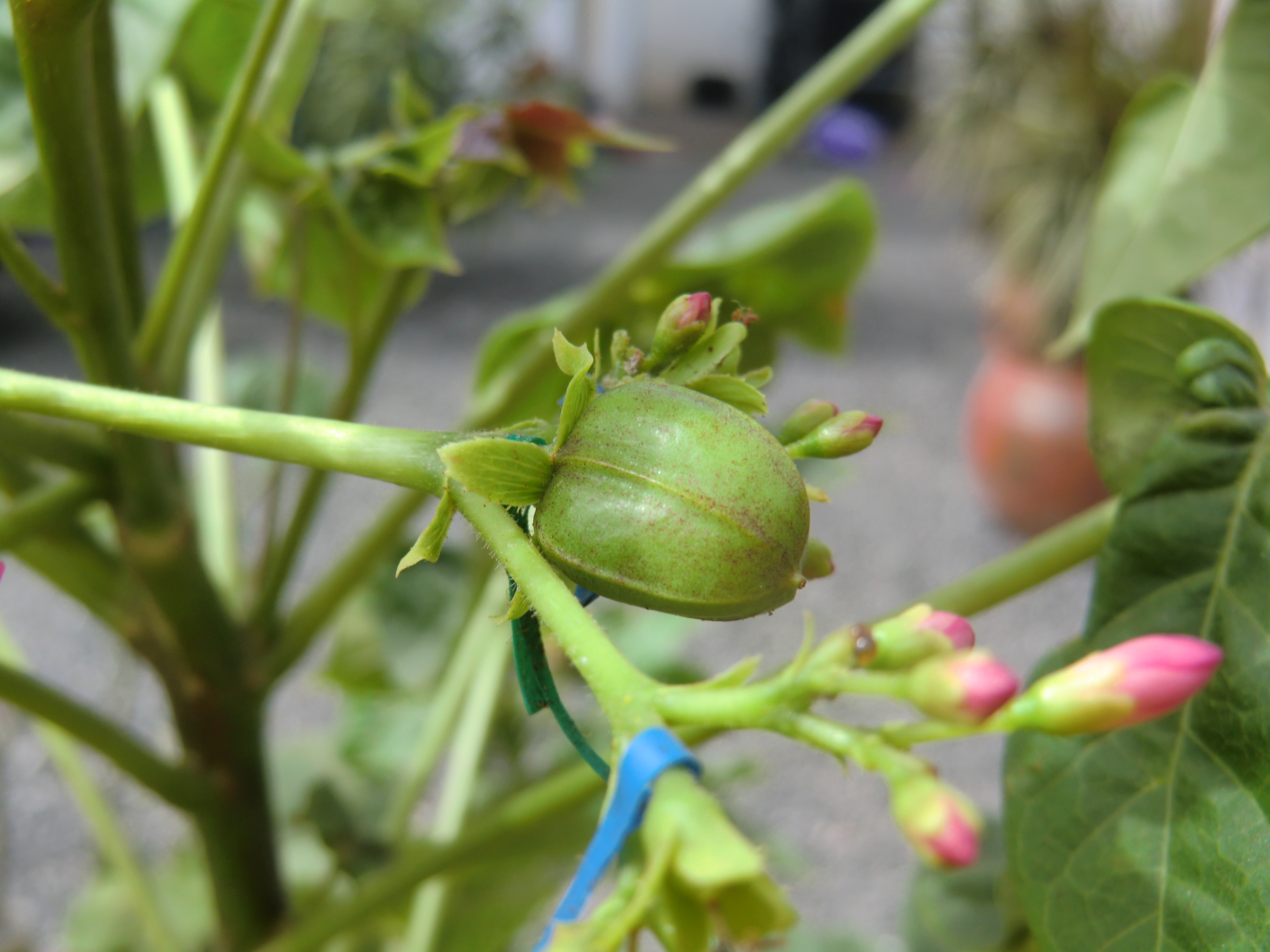
Fruit on an interspecific F1 hybrid
We expect our F2 interspecific population to grow very fast over the coming months involving many different F1 interspecific parents with genetically very different Jatropha curcas parents in turn. Currently many F1s are initiating their first flowering. On the interspecific route of our breeding program this is really what we have worked on for almost 3 years, as now we start moving into terrain which has not previously discussed in the scientific literature to the best of our knowledge.

This development marks another success in our initial target to bring as much variability into the germplasm available to us for future selective breeding. We are now able to work on a real ground breaking next step we had been planning for since we did the first interspecific cross almost 2 years ago. With a little luck results will become visible before the end of the year.

Further observations on the interspecific breeding route will be published here as much as possible, but of course we will have to start protecting our intellectual property where we reach the forefront of commercial hybrid development as we are expecting a meaningful patent application before too long.


F2 Jatropha interspecific hybrids available

Saturday, September 15, 2012

The new Bionic Cocoa project


At Bionic Palm an exciting new agriforestry project has been brought on the way. The Bionic Cocoa project will feature double hedges of Cocoa trees planted alongside local food crops like maize, pepper, tomatoes, okro, cocoa yam, plantain and more.

Bionic Palm’s experience from over 3 years of Jatropha/food crop farming will be a major input to the project which will be conducted in active cooperation with local families.

New forms of participation by the local farming community and land owners are being developed.

During a 2-3 year test phase all technical details and their feasibility will be worked out. The project is governed by the highest levels of sustainability including a completely organic approach, soil retaining inputs like mycorrhiza and other micro organisms, biochar soil amendments and no-till weed management. The Bionic Palm leadership is convinced, that the most environmentally and socially sustainable methods will also generate the most sustainable profit expectations combined with a lower risk in any life-cycle assessment of the project.

Find more about this project in the Cocoa section on the Bionic Palm website.


The new Bionic Cocoa project

Sunday, July 15, 2012

Bionic Palm has launched the Jatropha Breeder 3.0 Blog

After experimenting with the idea for almost a year Bionic Palm MD Ulrich B Riemann has finally decided to officially launch his new blog "The Jatropha Breeder 3.0 by Bionic Palm". This coincides with the successful end of an almost 24 months proof-of-concept (POC) testing our various ideas and concepts to improve the immensely under-performing Jatropha curcas species in its potential role as an energy and feed crop.

We were able to demonstrate with great success that our vision of high performing non-toxic Jatropha cultivars is not a dream, but in many ways a reality. Before the POC ended June 30th we were able to develop the first 12 seedlings of a highly variable back-cross generation (BC1). This generation of unique hybrids will be a cornerstone for various promising breeding approaches to come. Going forward many high yielding non-toxic and toxic varieties will be developed. We expect to reach our initial target of a high performing non-toxic elite cultivar within the coming 24 months. Field testing has already started with some unique early non-toxic intraspecific hybrids which will be used in long term poultry feed trials starting later this year.

Here at the Bionic Group we are all very excited to see what was achievable so far with a small network of scientific partners from Europe and a very small budget. A significant amount of valuable IP has been generated which will lead to a number of patent applications in the near future.

Thursday, March 24, 2011

Excellent new report on the future of Jatropha published

An excellent investor oriented 43 page report on Jatropha (JcL) has been published by Hardman & Co titled "Plant with a bad Name". It is definitely the best publication of this kind we have ever seen anywhere, a must read for any serious player in the industry. The full document can be downloaded here.
The report points out the simple fact, that spectacular failures in the past with a number of JcL projects are no indication for the performance of this crop in the future. The past was based on semi wild planting material and little agronomic knowledge on how to manage it correctly. There was simply not enough scientific and practical background for commercial JcL farming. The report shows in detail, how this situation is changing rapidly. "Professional planters, working with Jatropha crop scientists are now developing commercially sized and scalable plantations in suitable growing locations. These ventures have the potential to prove the commercial case for Jatropha as a biofuels feedstock." This statement from the report sums up all the contained details very well, which have been brought together in one place for the first time.

Bionic Palm itself is at the forefront of this development with its world class JcL breeding program and its integrated food & fuel farming concept. Both approaches are unique in several ways and the goals exceed highly marketed activities by others. That's why we started calling our platform JcL3.0.

We focus on the development of non toxic, high yielding hybrid cultivars in our genetic marker assisted breeding program where we partner with Geneticlab, a world leader in commercial research on molecular genetics of JcL. The report describes the great opportunities of a detoxification process for the  press cake, a process said to be commercially available by 2012/2013. We are very confident, that our focused hybrid breeding process will turn out the first commercially usable non-toxic planting material  within about the same time frame. Non-toxic or at least controlled low-toxic material is actually a must for the future protection of workers' health, as it is well known, that current JcL can become a serious long term health hazard to farm workers exposed to it for years. We will soon publish a document, that is going to look at the many advantages of non-toxic hybrid planting material vs. the current toxic one even with detoxification available.

Our integrated food & fuel farming is another piece of leading edge JcL development which we have been testing intensively over the last 3 years on our 150ha test plantation. This presentation explains most of the aspects involved in detail. The concept is highly sustainable, can reclaim depleted and eroded soils and generate food outputs currently unseen in Sub Saharan Africa, while still generating significant volumes of Jatropha products.

Saturday, January 29, 2011

Bionic Palm's Jatropha hybrid breeding program

1 year ago BPL started breeding for high yielding non-toxic Jatropha hybrids as part of the ambitious BIONIC JCL 3.0 program. Early interspecific hybrid results are very promising. An ongoing proof of concept phase should be completed before the end of 2011.
 
Jatropha curcas Lin (JcL) is a relatively new discovery for the world of non edible plant oils for energy and chemical use as a sustainable substitute for fossil crude oil. However, it is considered a very promising plant by experts given its ability to survive even under the hardest environmental conditions.

JcL hedges form the back bone of Bionic Palm's innovative food and fuel farming concept covering 30% of the farmed land and facilitate the recovery of previously depleted African farmland. 

The planting material currently in use by most plantation projects around the world is commercially insufficient and  mostly defined as wild accessions by scientists. An optimization through professional breeding programs  is desperately needed if this crop is to make it. Only domesticated hybrid varieties will eventually be able to meet investors and farmers expectations in terms of yield, oil quality and other important traits.

In addition, it would be of high commercial value, if "non-toxic" elite varieties could be developed. The byproduct from pressing oil, the oil cake, could be used as a high quality feed material for poultry and fish.
There is evidence from many scientific reports that the development of high yielding and non-toxic hybrids can be achieved through traditional breeding methods. However, the genetic variability of JcL has been reported to be very limited  recently. Therefore, an intraspecific breeding approach as marketed by some protagonists in the industry like SG Biofuels and Quinvita (former D1 plant sciences, just to name two), who are usually boasting with their large collections of Jatropha curcas material from around the world, does not promise stunning break throughs.

Bionic Palm's management team has been listening carefully to the scientific community and is following a radically different approach in its fast track program to make the first non-toxic true elite Jatropha cultivars available. Based on yet unpublished scientific work from the recent past, we have selected the most genetically suited 10 JcL accessions from around the world (including 4 non-toxic ones) together with a number of related varieties from the genus Jatropha as parent plants and mapped out a detailed interspecific hybrid breeding path.

The breeding process will be backed by genetic marker technology thus reducing time requirements by a factor of at least 3. We expect the first patentable results in 24 to 36 months. Bionic Palm has already spent over 18 months, to get the selected parental material in place at its Ghana research facility. The program has taken off in December 2010 with performing the first crossings of the program map.

The program has been designed with three guidelines in mind: Quick results, highly manageable and low risk. Successful results will not only change the economics of JcL profoundly, but also improve the working conditions for farm workers, who often suffer from allergic reactions after some years of intensive exposure to the plant and its seeds.

A special blog called "The Jatropha Breeder" shares more specific information and highlights about this activity.

Tuesday, January 25, 2011

Bionic Palm Ltd, our sustainable biomass feedstock company

Today we start talking about another area of activities within the Bionic Fuel Group, the African agricultural venture Bionic Palm Ltd. Ghana (BPL). The company was founded in 2007 and came a long way since then. An early attempt to take over an existing palm oil mill was terminated after a few months. Subsequently BPL started its "food and energy" project model in Ghana's coastal savannah about 50km outside of the capital Accra. This presentation gives an overview on what we are doing. We started a test farm which has currently reached a size of approx. 150ha.

Building on the test farm experience an innovative integrated farming model was designed which will be rolled out as soon as the necessary funding is in place. We expect to create at least 500 permanent jobs. We consider 5000ha as the upper limit for this project. Food:Energy ratio will be 7:3 in terms of land use.  However, food crops could not be grown with the same sustainable yields without Jatropha hedges, therefore we actually exceed the potential of food crops per ha without the hedges while only using 70% of the land.

The farm will produce quality food for the local markets especially in the urban center of Accra/Tema and generate its own energy from the farm waste.

The test farm employs 35 people permanently by now and grows local crops like chili pepper, maize, aubergines, onions, tomatoes and more. All of the planting takes place in between Jatropha double hedges in a cropping system called double alley planting. A poultry farm has also been started with chicken, guinea fowls and turkeys.

Between JcL hedges (640x480).jpg


There are many advantages to the Bionic farming system, which avoids the issues of mono cropping and improves water, soil and nutrient management.
Across the JcL hedges (640x480).jpg

A soil improvement program directed at depleted topical soils has been initiated involving biochar in combination with a system of mineral and biological amendments like mycorrhiza. Mid term only natural fertilizers will be used, like the Jatropha press cake, manure from our poltry farm, compost and more.

The model roll out will integrate a microfuel plant with agricultural "waste" as feedstock. It will come primarily from the annual pruning of the Jatropha hedges plus any additional waste deriving from growing food crops. The fuel will be used for the farm equipment, the biochar mixed with above mentioned biofertilizers and additives will return to the fields. Given the 100% use of biofuel and the additional carbon sequestration through adding the biochar to the soil should result in an actual carbon negative footprint of the farm.

In order to fill some availability gaps and to further improve the model BPL has decided to embark on its own R&D activities. A breeding program for Jatropha curcas Linn and localized food crops and a soil amendment biochar++ program are included to develop sustained optimal soil conditions in the tropical environment. Both programs have started and involve cooperations with strong research partners in the related fields.

Our R&D objectives:
Breeding programs:


  • Locally adapted elite, non-toxic Jatropha varieties
  • Localized improved varieties for tomatoes, chili pepper and aubergines

Biochar++:

  • Soil amendment concepts based on biochar that will overcome the agricultural issues of tropical savannah soil

I will certainly write more about both programs in the near future. in the mean time you can have a look at our extensive geotagged picture gallery documenting the development of the test farm from the very beginning.