Bionic management took a bold decision recently on the public sharing of information from its Jatropha Breeding Program. Only information directly connected to pending patent applications will in the future remain confidential. This means that the main bulk of information and developed knowledge from one of the world's most advanced commercial Jatropha breeding activities can and will be shared publicly over time.
Bionic wants to set an example in modern, more open information exchange policies in the sector of commercial plant development.
In a first step today the full presentation on the Bionic Jatropha Breeding Platform was made public on the Bionic Palm website. Check it out here Bionic Jatropha Breeding Platform to learn about the details of modern plant breeding.
Banner

Sunday, October 28, 2012


Sunday, September 30, 2012
Heterosis increases Jatropha seed weight 100% and more
 |
| Heterosis makes a difference in seed size! |
It has been only a month since we last wrote on heterosis in Jatropha breeding. However, we had not seen then, what we have seen now…
We have harvested a handfull of seeds from the intraspecific hybrid exhibiting by far the strongest heterosis effects in leave size and height. And we were up for a real surprise.
We had recently seen 2 scientific reports on heterosis trials with Jatropha in South East Asia mentioning maximum positive heterosis in seed weight of up to 25%. We therefore really had not expected to see our highest 100-seed weight so far. Extrapolated from 20 harvested seeds it is slightly above 110g. Seed size can be compared very well in the picture above with control (small seeds on the right) being a typical average size Jatropha seed at a 100-seed weight of 56g.
Sunday, September 16, 2012
F2 Jatropha interspecific hybrids available
In the second half of August we successfully germinated the first three F2 seedlings from one of our interspecific hybrids. From now we have F2 Jatropha interspecific hybrids available for further breeding. While some research reports seem to indicate that this type of interspecific hybrid is sterile or not interesting for breeding, we observe an ongoing successful seed development on several of our early F1 plants deriving from different Jatropha curcas female parents.

F2 seedlings of interspecific JcL hybrids 1 month old showing wide variation
As expected from applying general Mendel rules the F2 generation is much more genetically diverse than the F1 generation. Out of 3 seedlings so far, only the one on the left seems to be a strong and healthy plant while the other 2 are only moving along very slowly.
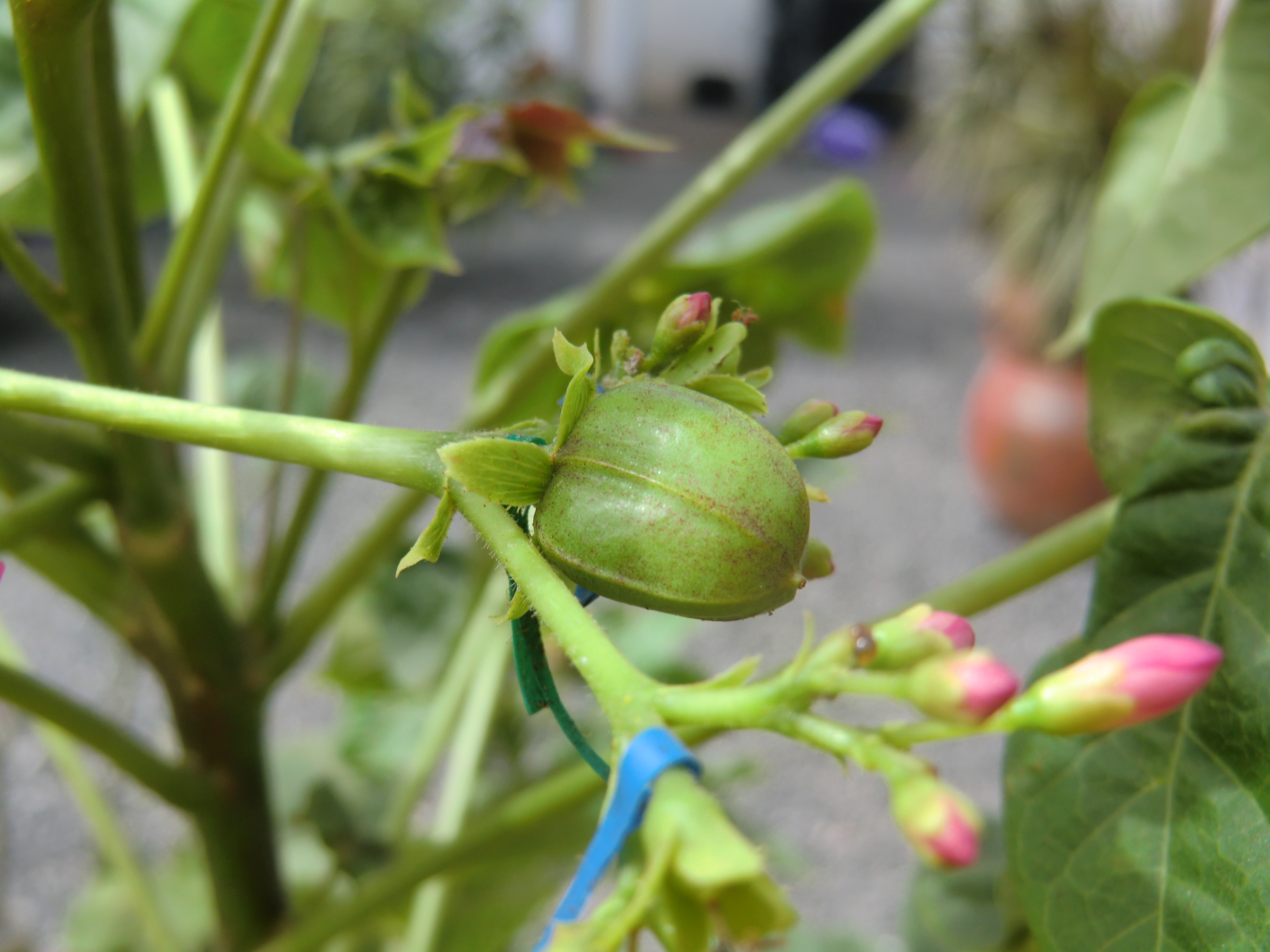 |
| Fruit on an interspecific F1 hybrid |
This development marks another success in our initial target to bring as much variability into the germplasm available to us for future selective breeding. We are now able to work on a real ground breaking next step we had been planning for since we did the first interspecific cross almost 2 years ago. With a little luck results will become visible before the end of the year.
Further observations on the interspecific breeding route will be published here as much as possible, but of course we will have to start protecting our intellectual property where we reach the forefront of commercial hybrid development as we are expecting a meaningful patent application before too long.
F2 Jatropha interspecific hybrids available
Saturday, September 15, 2012
The new Bionic Cocoa project
At Bionic Palm an exciting new agriforestry project has been brought on the way. The Bionic Cocoa project will feature double hedges of Cocoa trees planted alongside local food crops like maize, pepper, tomatoes, okro, cocoa yam, plantain and more.
Bionic Palm’s experience from over 3 years of Jatropha/food crop farming will be a major input to the project which will be conducted in active cooperation with local families.
New forms of participation by the local farming community and land owners are being developed.
During a 2-3 year test phase all technical details and their feasibility will be worked out. The project is governed by the highest levels of sustainability including a completely organic approach, soil retaining inputs like mycorrhiza and other micro organisms, biochar soil amendments and no-till weed management. The Bionic Palm leadership is convinced, that the most environmentally and socially sustainable methods will also generate the most sustainable profit expectations combined with a lower risk in any life-cycle assessment of the project.
Find more about this project in the Cocoa section on the Bionic Palm website.
The new Bionic Cocoa project
Subscribe to:
Posts (Atom)